
Chouara Tanneries: Fes’s Timeless Leather Craft – Travel Guide
The Chouara Tanneries are one of the most remarkable and historically significant attractions in Fes, Morocco. Located in the northeastern part of Fes El Bali, the old medina, they represent a craft tradition that has been practiced continuously since at least the 11th century. For nearly a thousand years, leather has been produced here using skilled manual labor, natural materials, and knowledge passed down through generations.
Fes itself has long been a center of learning, religion, and trade in the Islamic world. As the city grew, so did its artisanal quarters, each dedicated to a specific craft. Tanning naturally took place on the edge of the medina, near water sources, because of the large quantities of water required in the process. Chouara became the most prominent of the city’s tanneries, supplying leather to local markets and traders across North Africa and beyond.
The tanning process at Chouara follows a sequence that has changed very little over the centuries. Animal hides, mainly from cows, goats, and sheep, are first cleaned and softened in stone vats filled with water and natural substances. This prepares the hides to absorb dyes evenly and become supple rather than brittle. The work is done entirely by hand, requiring physical strength, coordination, and experience.
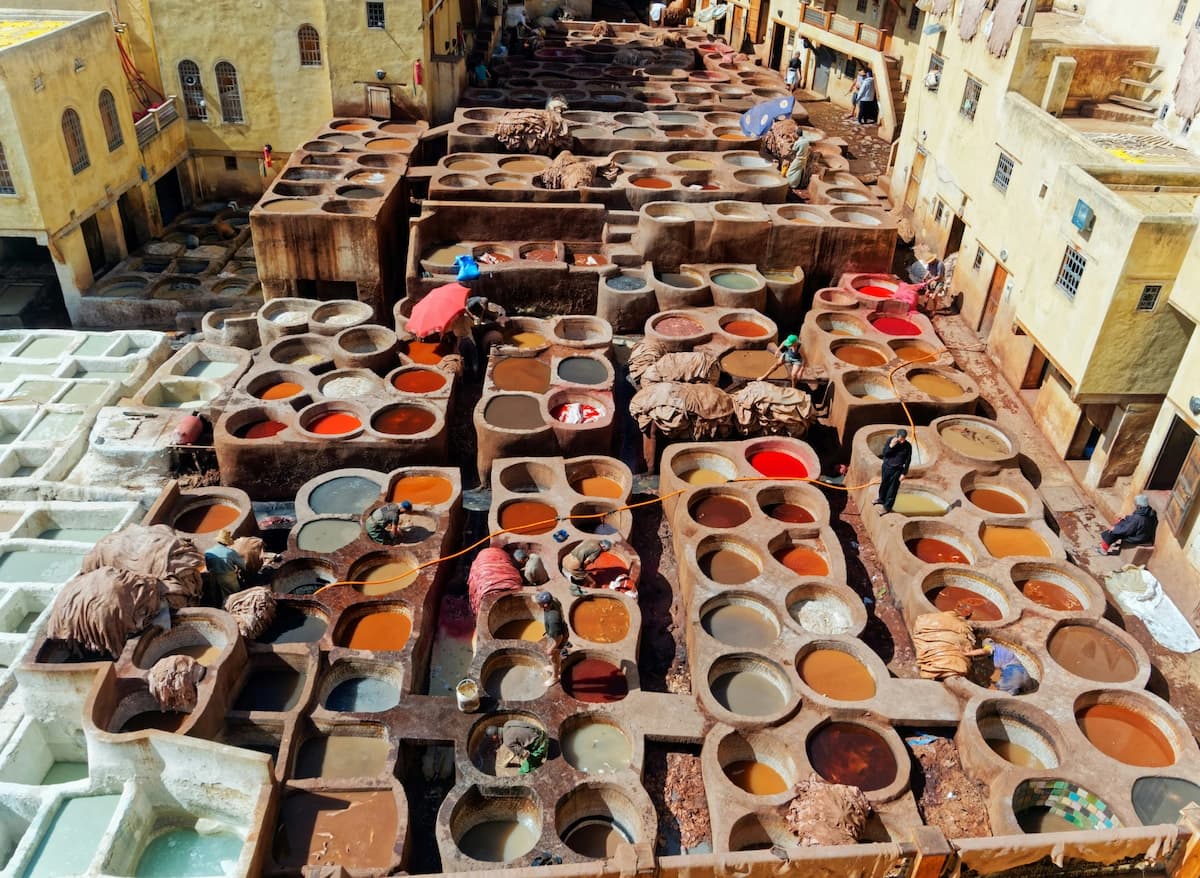
After preparation, the hides are transferred to dyeing vats. Colors come from natural sources used for generations: yellow from saffron, red from poppy flowers, blue from indigo, and brown from earth pigments. The hides are immersed, turned, and monitored until the desired color is achieved. Once dyed, they are laid out to dry under the sun before being sent to workshops elsewhere in the medina, where they are cut and transformed into finished goods.
One of the most striking aspects of the Chouara Tanneries is their visual appearance. From above, the circular stone vats form an organized yet organic pattern, filled with liquids in varying shades depending on the production stage. The elevated view allows visitors to understand the scale and coordination of the work, offering a respectful way to observe the tanners without interfering.
The leather produced at Chouara plays an important role in Fes’s artisanal economy, used for products such as babouches, bags, belts, book covers, and home décor items. Many are sold in the souks, while others are exported. Although tools and distribution have evolved, core tanning techniques remain rooted in tradition.
Beyond their economic function, the tanneries are a powerful symbol of continuity. Tanners often learn the trade from family members, starting young and mastering each step over time. This transmission ensures the craft remains alive as a genuine working tradition, not a reenactment for visitors.
Visiting Chouara provides insight into Fes El Bali itself. The medina is a living city where people work, study, and worship daily. The tanneries fit naturally into this environment, reflecting a balance between heritage and daily necessity, and helping visitors understand how traditional industries shaped the city’s layout and identity.
Today, the Chouara Tanneries are recognized as one of the most emblematic sights in Fes, attracting travelers interested in history, craftsmanship, and authentic cultural experiences. The techniques represent centuries of accumulated knowledge and adaptation, and their continued operation demonstrates the resilience of Moroccan artisanal traditions.