
Medrasa Ben Youssef: A Jewel of Moroccan Islamic Architecture and Learning – Travel Guide
In the cool hush of Marrakech’s old quarter, a visitor stepping from a narrow sunlit alley into the shaded marble courtyard of Medrasa Ben Youssef encounters an almost theatrical scene: a central pool reflects ornate arches, while light and shadow dance across carved plaster and colorful tiles. For centuries, students and visitors have paused at this view, sensing the intimate drama of learning, faith, and craftsmanship captured in stone.
The medrasa’s origins are intertwined with Morocco’s layered dynasties. It is named after the neighboring Ben Youssef Mosque, linked to the Almoravid ruler Ali ibn Yusuf in the early 12th century, but the current structure mainly dates from the Saadian period. Commissioned by Sultan Abdallah al-Ghalib, it was completed in 1564–1565 CE. Earlier institutions existed under the Marinids, but the Saadian reconstruction created the expansive and richly decorated complex celebrated today. At its peak, the medrasa housed hundreds of students studying Qur’anic recitation, Maliki jurisprudence, and related disciplines, making it one of the largest Islamic colleges in the Maghreb.
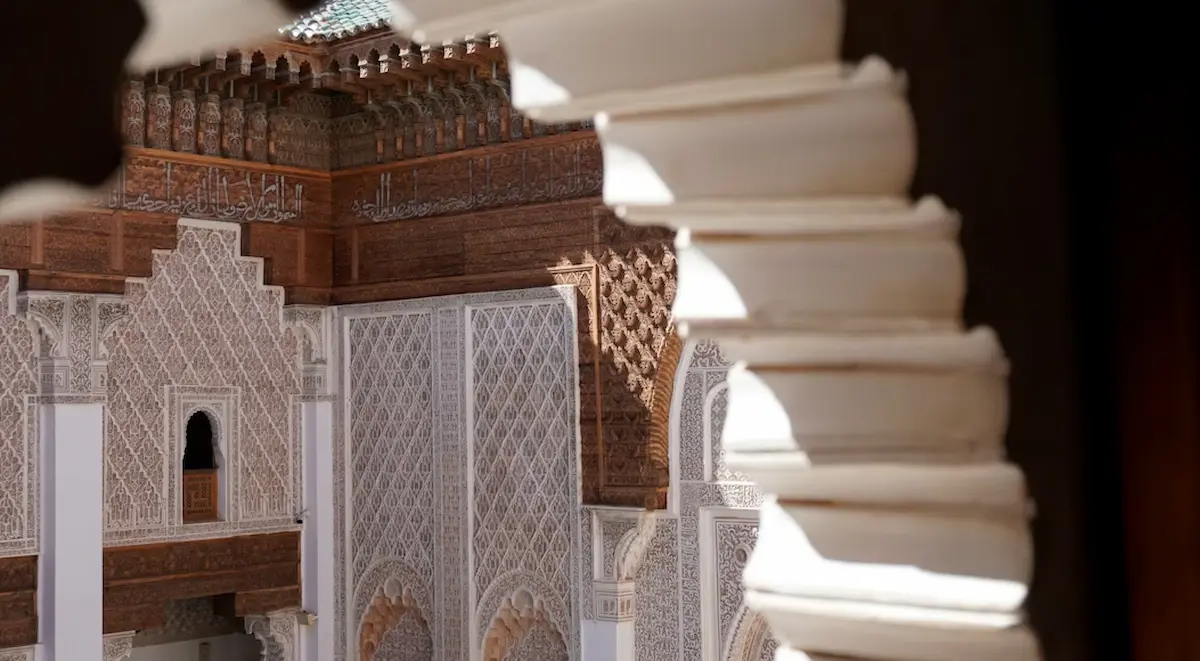
Visitors today witness a concentrated lesson in Moroccan decorative arts. Entering through a carved wooden door, one sees a rectangular marble courtyard centered on a shallow water basin, surrounded by two tiers of student rooms opening onto arcades. The walls are layered with zellij tilework up to waist height, followed by carved stucco panels, and topped by finely incised cedar wood cornices and ceilings. Each material and motif follows traditional Andalusi-Maghrebi patterns, including interlacing stars, calligraphic bands, and arabesques. Small details reward careful attention: the symmetry of student cells, the prayer room’s mihrab, and the seamless blending of structure and ornament by skilled artisans.
Medrasa Ben Youssef has long been a protected and visited monument. It was closed for conservation and reopened to the public after major restoration in April 2022. Today it operates as a museum-monument rather than an active school, welcoming visitors eager to learn about its history, artistry, and scholarly legacy. The compact site is rich in detail, encouraging slow observation; visitors can sit by the reflecting pool and watch light play across the tiles.
For reliable visitor information and background reading, the medrasa’s official website and respected travel guides remain the best sources. A visit to Medrasa Ben Youssef offers a window into Moroccan Islamic architecture, the Andalusi-Maghrebi decorative tradition, and centuries of learning and culture in the heart of Marrakech’s medina.