
Volubilis: Morocco’s Greatest Roman City and a Window Into Ancient Civilizations – Travel Guide
Volubilis is Morocco’s most celebrated classical ruin: a sprawling Roman town perched on the fertile plain beneath Jebel Zerhoun, a short drive north of Meknès. Its monumental remains — a triumphal arch, a basilica, public baths, and long colonnaded streets — trace the shape of a prosperous provincial capital that grew from a pre-Roman Berber settlement into the administrative heart of Mauretania Tingitana under Roman rule. Because a large portion of the site was excavated and partly restored in the 20th century, Volubilis offers unusually clear evidence of Roman urban planning on the empire’s western edge, which is why UNESCO inscribed it on the World Heritage List.
What surprises many visitors are the domestic details preserved in the houses of wealthy citizens: exceptionally fine mosaic floors, decorative friezes, and epigraphic inscriptions that reveal local elites, trade links and everyday life. Archaeology shows Volubilis developed over many centuries — first occupied in the pre-Roman era, expanded under the Mauritanian kings, then incorporated into the Roman Empire in the first century AD — and its economy was closely tied to olive cultivation and oil production for export. Excavations begun in the early 20th century and continued by Moroccan and international teams have exposed large private houses (domus) and public buildings that let us read the social geography of the ancient town.
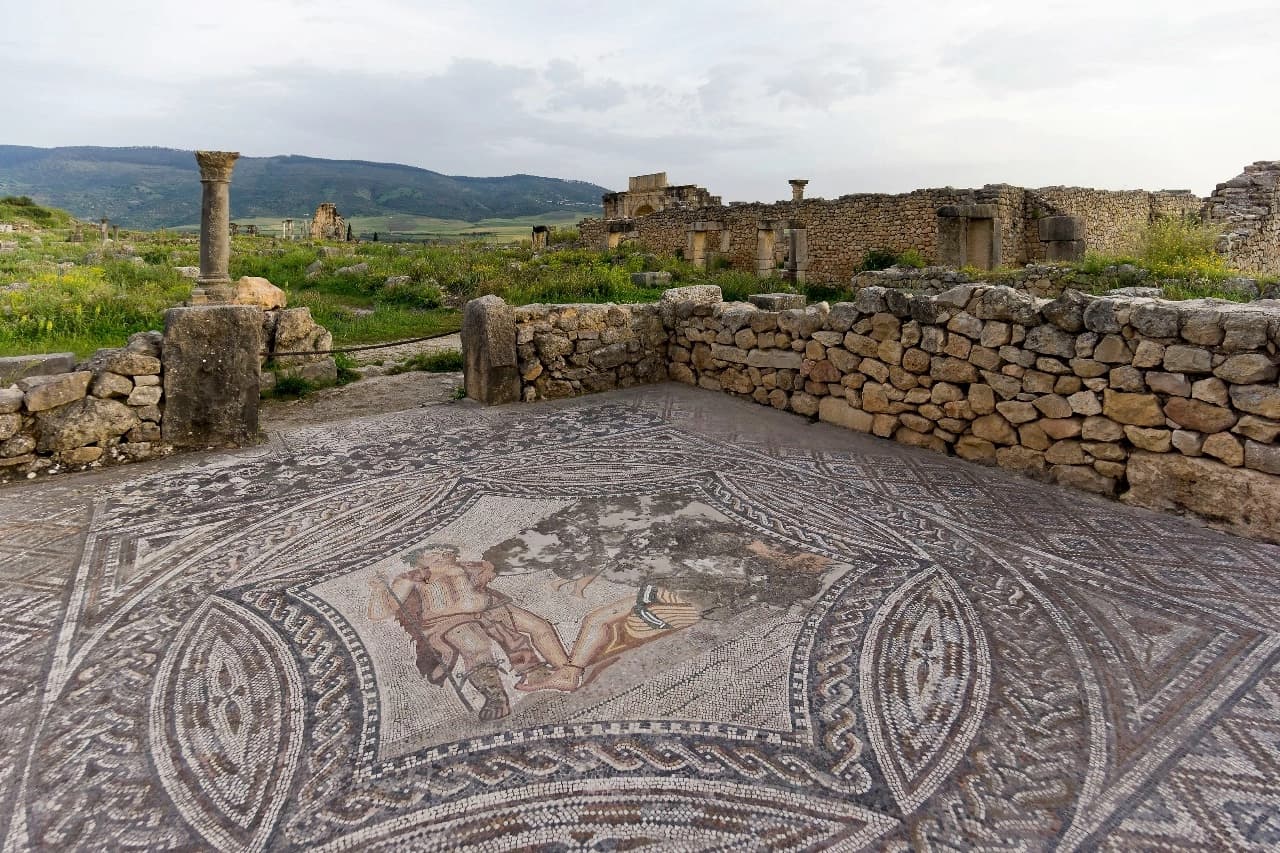
The mosaics at Volubilis are among its finest and most evocative features: geometric panels, mythological scenes and hunting tableaux survive in situ and give visitors a vivid sense of Roman taste adapted to local life. Conservation work has focused on stabilizing pavements and masonry while keeping the ruins legible for the public; still, large areas of the 42-hectare complex remain unexcavated, meaning the site can yield fresh discoveries in future campaigns. The visible architectural sequence — from Roman basilica and capitol area to later Christian and early Islamic layers — also makes Volubilis a key place for studying cultural continuity and change in northwest Africa.
Volubilis is not alone: Morocco preserves several other classical and pre-classical sites that complement its story. Near Rabat, the Chellah (ancient Sala Colonia) presents Roman foundations later overlaid by medieval Marinid necropolis architecture; recent archaeological campaigns at Chellah have expanded our understanding of its urban footprint and revealed baths and residential quarters. Up the Atlantic coast, Lixus (near Larache) preserves Phoenician, Punic and Roman layers and has yielded industrial and religious complexes, while Banasa and Thamusida are additional regional towns with forums, baths and mosaics that echo Volubilis’s urban vocabulary. Together these sites illustrate a mosaic of Phoenician, Berber, Roman and later Islamic activity rather than a single, simple story.
Today Volubilis is both a major tourist destination and an active archaeological landscape: visitors come for the mosaics, the skyline view across olive groves, and the chance to stand where millennia of Mediterranean and North African histories meet. Responsible visitation and continued conservation funding are essential — some parts of Morocco’s archaeological network still need greater care — and the fragments recovered from the site (mosaics, inscriptions, statuary) are now key objects in Moroccan museums. If you visit, combine the trip with nearby Moulay Idriss Zerhoun — the sacred town that later grew beside the ruins — and take time to reflect on how Volubilis encapsulates long-term encounters between local Amazigh cultures and successive Mediterranean civilizations.